How Infor WMS Improves Order Accuracy in 3PL Warehouses?
November 28, 2025
How ERP Improves Efficiency in Germany’s Auto Aftermarket & Spare Parts Business
December 23, 2025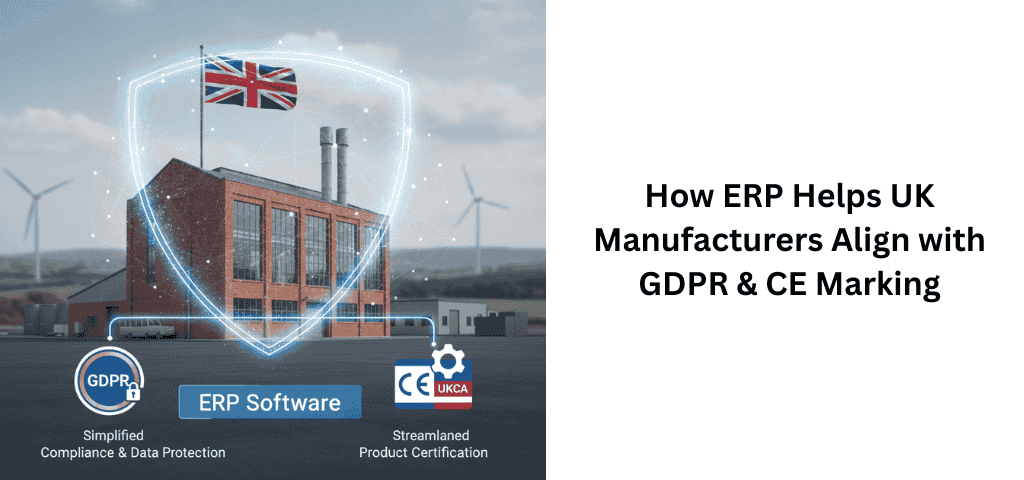
How ERP Helps UK Manufacturers Align with GDPR & CE Marking
In these highly complicated times for the post-Brexit UK manufacturing scenario, compliance with regulatory frameworks becomes essential. A manufacturer in the United Kingdom may be required to comply with sometimes conflicting standards in the case of GDPR on the EU side, and commercial market access through CE Marking on the other. If put in different ways, it rests on double efficiency; thus, conducting a proper check on a Manufacturing ERP UK GDPR system shall forever be key. An ERP system has outgrown the category of business management tool. It now stands as a strategic tool for regulatory compliance through proficient ERP software.
The Dual Compliance Challenge
UK manufacturers face a unique confluence of compliance demands:
- Data Security and Privacy (GDPR): The UK GDPR establishes very tight requirements on how personal data about employees, suppliers, and customers can be collected, held, processed, and protected. With non-compliance, the biggest damage is levied on a company's reputation.
- Product Safety and Quality (CE Marking): CE Marking is a mandatory certification for a vast range of products sold within the European Economic Area (EEA), signifying conformity with health, safety, and environmental protection standards. While the UK introduced the UKCA mark, the CE mark remains vital for most products destined for the EU.
ERP for GDPR Compliance: Securing the Data Foundation
An effective ERP for UK manufacturers fundamentally changes how data is managed, directly addressing the core principles of GDPR.
Centralised, Secure Data Management
The modern Cloud ERP for GDPR and CE Marking compliance acts as a single, central repository for all business data. This eliminates the risk of sensitive personal data being scattered across vulnerable spreadsheets or disparate systems.
- Data Security in Manufacturing: ERP systems in manufacturing enhance data security through advanced encryption, multi-factor authentication, and strict access controls. Role-based security is defined such that only authorized individuals have access to view or process certain categories of personal data.
- The Right to Be Forgotten and Access: GDPR grants individuals the "right to be forgotten" (erasure) and the right to request access to their data. An integrated GDPR compliant ERP software UK enables manufacturers to quickly and thoroughly locate all records about an individual—from HR files to customer service logs—and comply with deletion or access requests in a timely and demonstrable manner.
- Audit Trails and Accountability: ERP platforms automatically log and track every change and access to data, creating an unalterable audit trail. This feature is critical for the "Accountability" principle of GDPR, allowing manufacturers to quickly demonstrate their compliance measures to regulators. How ERP helps manufacturers comply with GDPR in the UK is largely through this granular, demonstrable control over personal data.
ERP for CE Marking Compliance: Traceability and Quality Control
While GDPR focuses on people's data, ERP for CE Marking compliance focuses on product data, quality, and traceability—all essential elements for achieving and maintaining certification.End-to-End Product Traceability
ERP for product certification (CE marking) is invaluable in establishing and documenting every step in the life of a product, thereby proving it conforms.- Batch and Lot Tracking: It streamlines the entire operations with real-time end-to-end traceability. Manufacturers can track every component, from raw material batch to finished good, and then to the shipment destination. In the event of any issue concerning quality or a recall, the ERP can quickly detect batches that will be affected, and accordingly, an extremely focused response can be taken vital aspect in keeping access to the markets.
- Quality Management Integration:The integrated quality management modules standardize the quality checks and automate the recording of inspection results, non-conformances, and CAPA. These are the imperative documented evidence to prove that the product conforms to relevant EU safety standards and that the CE Mark is consequently valid.
Technical Documentation and Reporting
The CE Marking requires the manufacturer to prepare a Technical File that shall contain all pertinent documentation, like specifications for design, risk analysis, test reports, Declaration of Conformity, and others.- Document Control: The ERP manages all documents in a centralized process and keeps these documents linked to the related Bill of Materials (BOM) and production history of products, thus assuring that up-to-date and complete documentation is served in an audit.
- Automated Compliance Reporting: Numerous CE Marking ERP software can create detailed reports automatically for the Declaration of Conformity. This would be assembled pursuant to real-time production and quality data records and then signed as a legal statement of compliance.
The Role of ERP in Regulatory Compliance for Manufacturers
Choosing a full-fledged ERP for UK manufacturers becomes a strategic investment that brings with it major ERP compliance advantages for the UK manufacturers. Such unification of all operational data-from customer contacts (GDPR) to material certificates (CE Marking), into a single integrated system is quite helpful. It gives manufacturers the critical visibility, control, and documentation necessary to satisfy the requirements of both regimes.ERP becomes the backbone of regulatory compliance for manufacturers, transforming complicated, manual, and high-risk compliance activities into a streamlined, secure, and auditable process. Against the ever-changing pace of regulation, the ERP system is the foundation for sustainable compliance and commercial success.