Salesforce vs. Infor vs. Rootstock ERP: Which ERP is best for your Industry?
March 18, 2026
Infor ERP CloudSuite vs. On-Premise: How Coserve Helps You Decide Which Path to Take?
April 30, 2026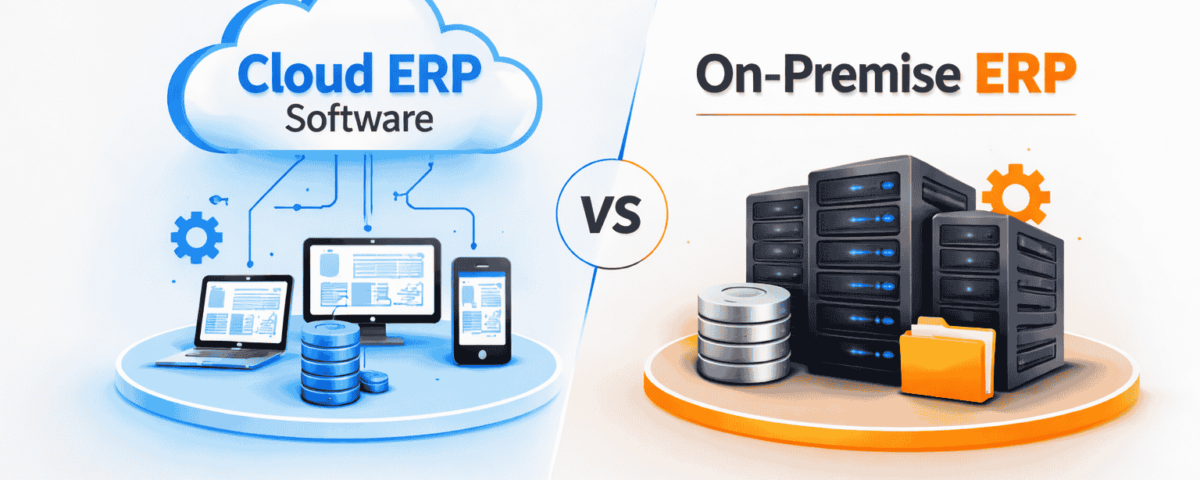
Cloud ERP Software vs On-Premise ERP: Which Is Best for Your Business?
Choosing the right ERP software can be a transformational decision that has a direct impact even on the less glamorous areas of business such as operational efficiency, scalability, and long-term costs. Considering the global trend of ERP software companies in the USA, UK, and India upgrading their systems, the key question is: which model is more beneficial—Cloud ERP or traditional on-premise ERP? The final choice depends solely on your company's specific requirements, fiscal organization, and IT proficiency.
The Cloud ERP Advantage
Cloud ERP Software is a service (SaaS) provided by a vendor, located on a vendor's far-off servers and available on the Internet. This model is responsible for the rapid global cloud ERP adoption as it has been the major factor to offer various advantages of ERP especially to small and mid-sized companies (SMEs) and modern, globally distributed enterprises.
The first and foremost reason to this is the use of capital money. There is nothing like the huge initial capital outlay in buying servers, hardware, or perpetual software licenses. Cloud ERP is so smooth and simple that there is just a monthly or yearly payment of a pre-determined amount as a subscription per business which changes over time from a capital expense (CapEx) to an operating expense (OpEx) altogether.
On the other hand, quick installation and elasticity are the main reasons. Cloud ERP systems can be put in place much sooner than their on-premise counterparts. It means that the time to realize the value of the system is also shorter. On the other hand, if a company wants to quickly expand its operations, it can do so easily and instantly by adding new users, storage, or new functionalities. Besides all these, the vendor takes care of all routine tasks. These tasks include maintaining the infrastructure and handling upgrades, security patches, and customer support, which significantly reduces the IT burden. Hence, the main advantage is that IT support needed is less. In this scenario, internal IT teams can devote their time and resources to strategic initiatives rather than system administration tasks.
Furthermore, users enjoy the advantages of being able to work from different locations and being able to access the system practically anytime, anywhere, provided that they have an internet connection and the right device. The need for this type of access is particularly strong for modern workers, mobile sales teams, and manufacturing operations with their different locations. The cloud continues to be the preferred destination for ERP migration, thus providing the foundation for making your business future-ready.
The On-Premise Approach
On-premise ERP software is the one that gets installed and is run on the computers of the company itself, normally inside the company's data center. The company pays a one-time fee for the software license and takes full responsibility for the hardware, installation, maintenance, and security.
The main advantage of this model is the absolute supervision and personalization. Firms having very complicated, sector-specific operations or very strict supervisory requirements can customize the software to the utmost without any limitations imposed by the vendor, as they have complete access to and control over the infrastructure, data, and system security.
Though the upfront cost is high, for very large businesses with constant user bases, the long-term cost model for ten years or more can sometimes be lower than the cumulative subscription fees for Cloud ERP software. Moreover, for companies that deal with exceptionally sensitive information or those that work in highly regulated areas, having the data on the premises could provide not only a stronger perceived security and control but also all the data governance protocols being managed internally. Nevertheless, one has to deal with the limitation of scaling, which entails upgrading the physical hardware, while the deployment is often slower, sometimes taking several months.
Making the Final Decision
Choosing between Cloud ERP Software and On-Premise ERP systems is not about selecting a single type of system to suit all requirements. It is a matter of judging the pros and cons depending on the factors like budget, IT resources, and level of customization required.
The trade-offs in favor of Cloud ERP are usually the thing for most modern businesses and particularly for SMEs in the markets of cloud erp software in India, the cloud erp software in UK, and the cloud erp software in USA where the entry cost is lower, IT management is minimal, and agility is stronger. Cloud ERP is sold on a subscription (OpEx) basis with rapid deployment and great, always-on scaling options.
How Coserve Helps You Decide the Right Infor ERP Path
On the other hand, On-premise ERP comes with a considerable initial CapEx, longer deployment, and limited, dependent on hardware scalability but at the same time gives maximum flexibility and in-depth customization with maintenance done completely by the internal IT department.
If your business is on a tight budget, prefers OpEx, requires quick deployment, and is willing to pay for mobility, then Cloud ERP is most probably your best option.